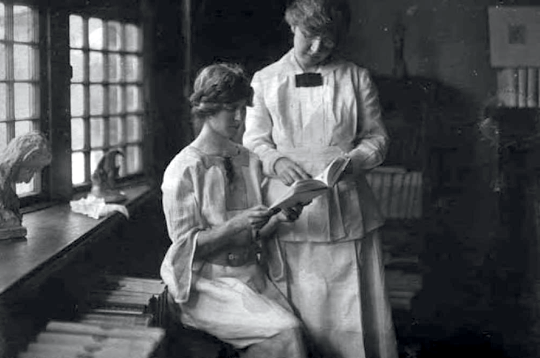
In her research on women booksellers, Barbara A. Brannon found that between 1905-1915 there were “only thirty-eight female proprietors, co-owners, or managers” of bookstores. Most of these women “were wives or daughters inheriting their husband’s or father’s enterprises; female clerks managing bookselling operations owned by men; or women setting up shop for themselves in frontier towns as the population expanded westward” (p. 16).
Madge Jenison and Mary Mowbray-Clarke were women of the leisure class. They chose to do work that fulfilled them and that they felt contributed to society.
Madge Jenison (1874-1960)
Jenison was born and grew up in Chicago, the daughter of Caroline M. Spooner and Edward S. Jenison, a prominent architect. She taught English at the Kenosha (Wisconsin) High School from 1904-1907 before accepting a position as the chair of the English Literature department at the Craven School in Newark, NJ. She was a magazine writer at the time the Sunwise Turn opened and would go on to publish several books.
The American Booksellers Association excluded women from membership, so Jenison co-founded the Women’s National Book Association in 1917. She served as their second president.
Mary Mowbray-Clarke (1874-1962)
Mowbray-Clarke was an art critic and lecturer. She may have taught a bookselling course at Simmons College (now University), which offered two courses in the subject as part of a one year program in their library program for college graduates.
It was because of Mowbray-Clarke’s husband that she met Jenison. He had been seated next to Jenison at a dinner event and thought her interesting. The three became friends shortly after. John Frederick Mowbray-Clarke was a sculpture and part of the modernist art movement. He helped organize the 1913 Armory Show which was the first exhibition of modernist art in the United States.
Another interesting connection to modernist art and bookselling is Fanny Butcher’s shop in Chicago. Initially she was going to sell books in the corner of a modernist art exhibition. The art never arrived and the man who had secured the lease told her she may as well use it for a bookstore.
When finalizing the sale of the Sunwise Turn to Doubleday in 1927, Mowbray-Clarke had requested to stay on in some capcity. Her request was denied. She would go on to find a new passion as a landscape artist.
Friends until the end
Ted Bishop’s article on the Sunwise Turn in The Rise of the Modernist Bookshop discusses tensions in the early 1920s between the cofounders as Jenison was leaving the business. He wrote that by the time Jenison left, she and Mowbray-Clarke were communicating only through lawyers. Justin Duerr, who is writing a two volume biography of Mowbray-Clarke, learned through archival research that the Sunwise Turn actually hosted the book launch celebration for Jenison’s memoir a few years after she left the business. He also confirmed that they stayed friends until the end of their lives.
This is significant not because it is a happy ending but because it is important to recover and study business relationships between women. Their experience can help shed light on womens’ business practices and leadership, and helps combat stereotypes of women not working well together or not being able to separate business and private life.
 Women Booksellers