The scene in April 1916 when Jenison and Mowbray-Clarke opened the Sunwise Turn was one of great change that touched virtually all corners of the world, including the book trade. The Suffragist movement was going strong and The Great War, the war that everyone thought would be over in a few weeks, was in its second year. Although the United States would not enter the war until April 1917, its impact was being felt in the book industry due to paper shortages and an increased demand for war related books.
In recent decades, the book trade had seen a trememous increase in the number of titles published each year. Technological advacements in paper, ink, and mechanized printing presses made the production of books faster and more efficient. Outlets that sold books were also changing. Big department stores like Macy’s and Gimbles started carrying books. Publishing houses were opening their own bookstores.
Faster, cheaper, and more seemed to be the new mantra. But not everyone was comfortable with the mass production of books. As in the Little Theater and the Little Magazine movement, some people wanted smaller, more intimate bookshops where the focus was on quality over quantity and the booksellers knew their stock.
Bookstore Interiors
Larger bookstores in the mid-nineteenth century were cavernous. As in this example of John P. Jewett & Co.’s “New and Spacious Bookstore” in Boston, circa 1850-59.

Smaller bookshops were often set up like other types of retail business, with items shelved behind a counter. Customers would stand at the counter and consult with an employee who would retrieve the requested items off the shelf or from the back storeroom. The photo below is of a bookshop in Næstved, Denmark taken between 1895-1910.

However, some shops did allow customers to mingle with the merchandise, such at the Old Corner Book Shop in Boston. The photo below was taken in 1883.
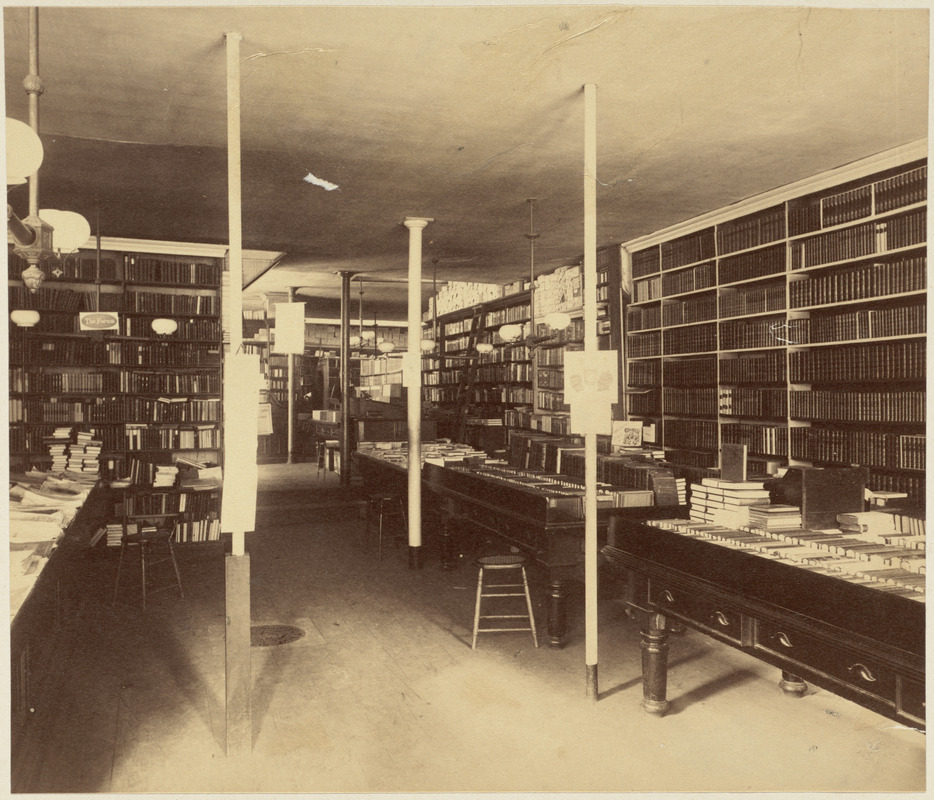
And in the undated advertisement card from Paine’s Student Store, which sold books, customers were encouraged to “come in and browse around.”

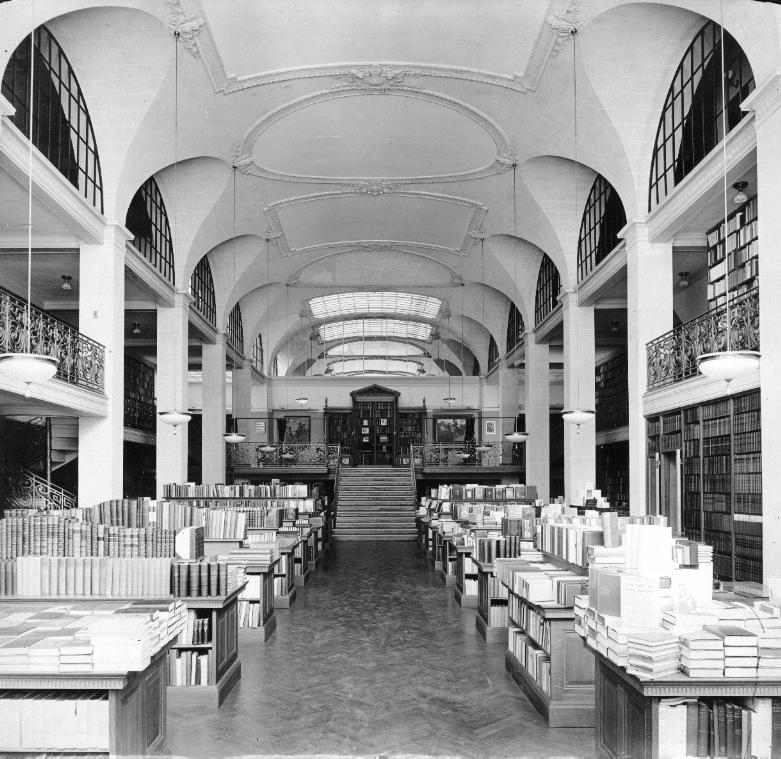
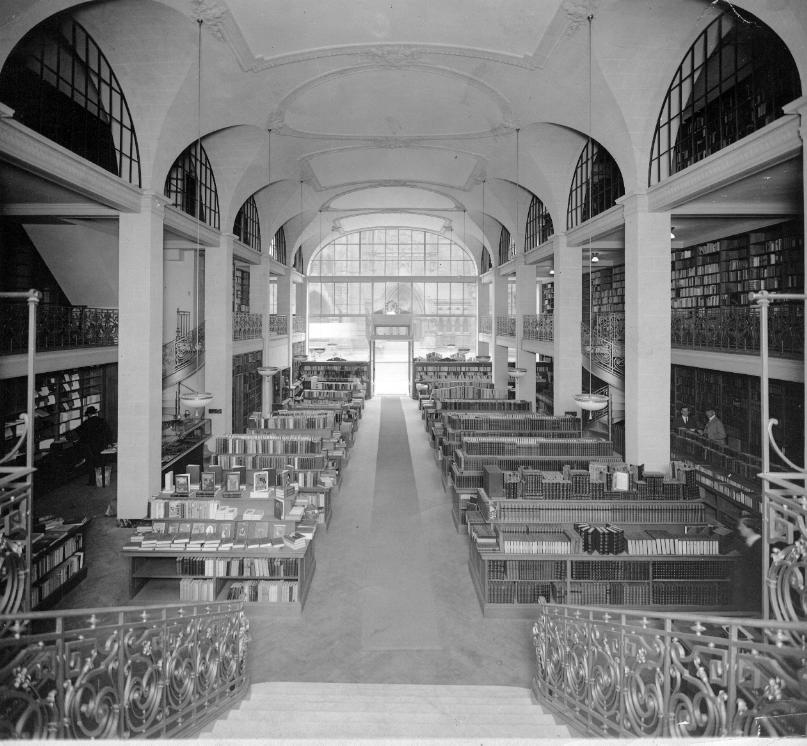
So while browsing may not have been new an entirely new concept for bookstore patrons, the larger bookstores may have been overwhelming. There is the impersonal factor, similar to today’s big box stores that some shoppers avoid. Below are two views of the main floor of Scribner’s multi-level bookstore which opened in 1913.
The Sunwise Turn Difference
What Jenison and Mowbray-Clarke wanted to create was a bookshop where people could come in and browse and even sit and read for a while. If you look back through the photos above, you’ll notice there are no reading chairs in the stores above (although the Old Corner Book Store had a few stools).
The Sunwise Turn opened in 1916 at 2 East 31st Street. It was on the corner of 5th Avenue, just under a mile south of Scribner’s (pictured above) which was at 597 5th Ave. Below is photo of its interior.
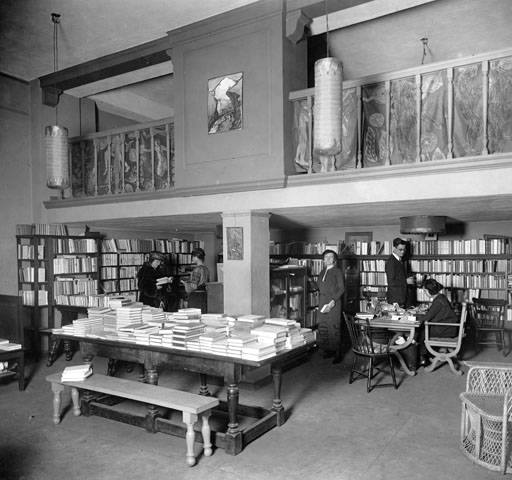
As you can see, the bookshelves are accessible to customers and there are a variety of places to sit and read or have a conversation. The walls were painted a bright orange, the electric lights were softened with fabric shades, and modern art, which was also for sale, hung on the walls. Reviews were encouraging and the business did well.
It was written up in a Canadian newspaper, The Daily British Whig, which described the shop as “a great big cozy living room, with a sun, gay curtained window seat, an open fireplace, cozy wicker chairs and tables with just a few inviting books lying carelessly on them” (Nov 5, 1919, page 12). This article makes the point that from the outside the shop looks like “a quaint old corner of London, years ago–perhaps in Dickens’ time,” but goes on to describe Jenison’s and Mowbray-Clarke’s new ideas and approach to bookselling.
The rent at their first location was $75 a month “from October to June, and $50 for the four months of the summer when we expected to be in complete collapse” (Jenison, p.15).* Jenison goes on to say that this rent was “incredibly low.”
In 1919, the property The Sunwise Turn rented was marked for development, so they moved to a retail space in the Yale Club at 51 E. 44th Street. The Yale Club building was new, it had been completed in 1914. The space was larger and new, and its prime location next to Grand Central Terminal, contributed to a raise in rent. As you can see from the photo below of the Yale Club just after it’s completion, it had a very different vibe.

Jenison left the business in 192X after Mowbray-Clarke and new business partners bought out her share. These new partners did not last long and moved on within a year. Mowbray-Clarke valiantly kept the business going until 1927 when she sold it to Doubleday (which also purchased Fanny Butcher’s bookshop in Chicago the same year).
Eleven years is a good run for a business in New York. Although Americans have a reputation for always wanting the shiny new thing, we do tend to pay more attention to businesses that have been in operation for decades, but the truth is, those businesses are often the exception. Just as the historical record is skewed when women and minorities are left out, so is the history of bookselling not complete without looking at all bookstores.
 Women Booksellers